Golden Cap
The Salt PathGolden Cap, the highest point on the south coast, is a landmark on the coastal walk where harsh weather, a family memory, and an unexpected change in Moth’s movement converge. Its fog-shrouded summit offers no clear view, but the trig point there gives Moth a chance to repeat a familiar gesture from family walks—and turns an ordinary marker into the scene of an astonishing, if unexplained, improvement in his condition.
Setting and ascent
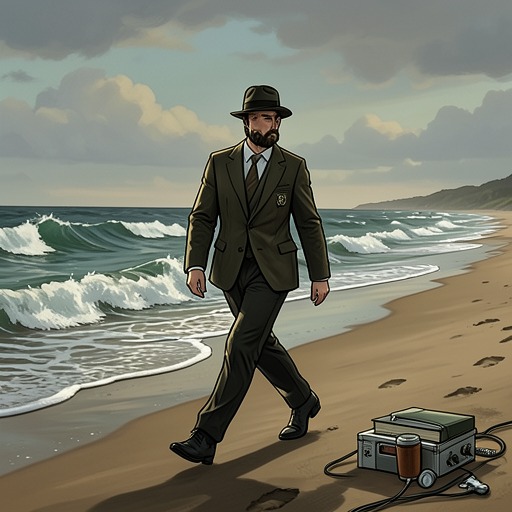
The approach to Golden Cap unfolds in bad weather. After a night in which the tent held against an increasing wind, rain swept in at first light and drove Ray and Moth downhill and onward. The gusts roared through a maize field, clattering its tall stems, then passed and left a dense, cloying mist. They climbed Golden Cap in the cloud; there was no visible explanation for its name, but its status as the south coast’s highest point made reaching the summit worth celebrating.
The trig point stood among clumps of broom, with paths leading away in directions hidden by the fog. The summit offered neither a panorama nor a reliable sense of where those paths went. Instead, the conditions narrowed attention to the immediate task and to the familiar object on the hilltop. That obscured setting matters: the scene’s revelation comes not from a view across the landscape, but from watching Moth move.
A family ritual at the trig point
The trig point recalls the couple’s earlier life in the mountainous countryside of Wales, where they walked whenever they had time. Their children were still preschoolers when they climbed their first mountain. As they grew older, cold weather and arduous walks could make them reluctant to continue, so Moth developed a way to lift their spirits: whenever the family reached a trig point, he would climb onto it, lie flat on his stomach, and pretend to fly for a photograph.
At Golden Cap, that playful pose carries the memory of the children and of a shared family tradition into the couple’s present journey. Moth has corticobasal degeneration, and Ray pauses to ask whether he can get onto the column without hurting himself. The question makes the old ritual newly uncertain: what once served to encourage tired children might now put Moth’s own body at risk. Yet the gesture also offers a measure of continuity. On a hilltop far from their former home, a familiar family practice is still available to them, though its physical cost can no longer be taken for granted.
The summit reversal
Moth takes off his pack, places his hands over the top of the column, and hoists himself onto it. Ray waits for a cry of pain and the self-reproach that might follow an injudicious effort. Neither comes. Moth spreads his arms as if flying through the clouds; Ray runs around him taking photographs, unsure whether she is recording the first time he has flown or the last.
His face is clear, he is not concealing pain, and he is laughing. In the fog-bound heather, the couple hug, jump, laugh, and kiss. The scale of the change is difficult for Ray to absorb: less than two weeks earlier, Moth could not get out of bed; now he seems strong and in control of his limbs. His improvement has been developing over the previous few days, but Ray had not registered that the drag in his footprints had disappeared. Golden Cap makes that gradual change unmistakable in a single, joyful action.
The episode does not establish a cure or a medical explanation. Ray and Moth consider whether the deep breathing encouraged by the path might have increased the oxygen reaching Moth’s brain, while acknowledging that the idea does not readily explain why such a simple intervention would not be used in hospital. Moth instead connects the change, tentatively, to heavy endurance exercise. He cannot explain how it works; he can only say that he feels great. The scene holds the exhilaration of improvement alongside the uncertainty of not knowing how long it will last.
Meaning within the journey
Golden Cap’s significance lies in the contrast between the limitations the couple fear and the movement Moth can manage at the summit. Ray’s concern about pain gives way to a sight that seems, for a moment, to suspend those expectations: Moth is laughing, balancing on the trig point, and spreading his arms in the old flying pose. The weather does not clear, and no distant prospect confirms what comes next. The brief freedom is bodily and immediate, made vivid against the fog and the remembered possibility of decline.
The moment also resists turning hope into a plan. Their exchange after the celebration includes caution against being careful on the stairs and against planning too far ahead. That restraint fits the scene’s unresolved nature: the improvement is real to them, but its cause and duration are not known. Golden Cap therefore becomes less a place of answers than a place where the couple can register what has changed today. On its hidden paths and mist-covered summit, a remembered family game briefly becomes proof of present ability, without becoming a promise about the future.